Imagine you and your most trusted hunting partner are heading out on the hunt of a lifetime…  You're backpacking into the High Country for 10-14 days.  Although you always want to be prepared for anything you know deep down that the unthinkable is a reality on trips like these.  You know some of the country you travel in…  You know how rough it can be and the outcome of your trip can change in the blink of an eye for better or for worse. 

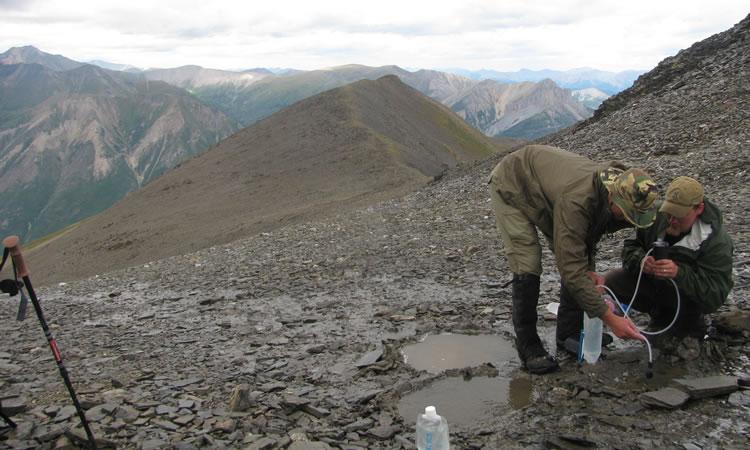
A few days into your trip and you're walking along a high rocky ridge and you run into an old slide… You know the kind with big trunk sized boulders that can shift out from under you.  It's tricky terrain loaded down with a pack.  You're stepping along from rock to rock and all of a sudden you hear your buddy yell as the rock he stepped on has just shifted and he's falling forward.  The weight of his heavy pack pushes him head first into the rocks and you see he's hit hard.  So hard in fact, that your partner is unconsciouss, bleeding badly and seriously in trouble…  You are 20 miles from the nearest road… There are no gas stations with a payphone nearby, no cell phones, no clinics, no hospitals, nobody to turn to…  You are ALONE.

Maybe you've got a satellite phone.  They are heavy, expensive and most of us have to rent them.  They don't always work 100%.  But it could save the day.  This is just one of 1000's of scenarios that could happen to one of us while enjoying our favorite pastime in the great outdoors.

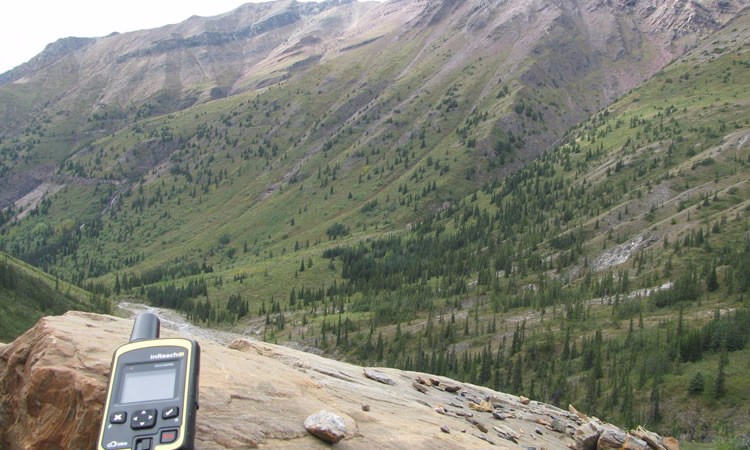
SPOT Satellite Tracking DeviceThe device I am about to tell you about is going to save lives.  And it's going to cost about the same as a weeks satellite phone rental. I first heard about SPOT a few months ago but never took the time to really check out their website until recently.

Coming from someone with a wife and two kids I can tell you this is an item I couldn't have acquired fast enough!  This is going to go with me on any and all of my backcountry trips from now on. For you guys who like to hunt in the most remote places across the world you owe it to yourself and your loved ones to have one of these in your pack.  God forbid it helps save your life one day.

So what is SPOT…?  It's a personal GPS tracking system.  In short, it gives you the ability to press a button in the event of an emergency.  Your signal will be routed directly to a local 911 call center along with a Google map and coordinates to locate you immediately.  You push the button and help is on the way.  This device takes the SEARCH out of Search & Rescue.

It also gives you the ability to allow loved ones to track your progress on Google Maps, and let them know you're ok.  Your family will thank you for this.

SPOT runs on 2 AA Lithium batteries and according to the manual the batteries will last for a very, very long time.  Longer then most 10-14 backpacking trips for sure.  The device is not much larger then a standard cell-phone and for the peace of mind it brings it's worth the extra 8 ounces in your pack.

I took my SPOT device out onto the logging roads behind my house today for a quick little test.  I turned the unit on and waited approximately 2 minutes.  I then activated the "Check-In" feature that sends my personalized "I Am OK" message to the contacts on my SPOT-team (friends and family). 

The email was received into my inbox virtually instantly.  Less then 1 minute on this test and thats pretty fast.  Here is the message that SPOT sent my contacts.

Just checking in.  I am okay.  We are at the location provided.
ESN:0-7392277
Latitude:49.3151
Longitude:-124.5979
Nearest Location: Dunsmuir, Canada
Distance: 8 km(s)
Time:04/05/2008 16:37:24 (GMT) 
Link To Location Via Google Maps
 

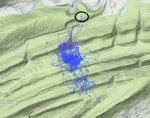
I did spend the extra $49.00 for the tracking feature which when turned on will track your progress every 10 minutes and mark your locations on a Google Map that your SPOT-team can login and view whenever they like.  It's an incredibly useful little feature.

When all was said and done SPOT cost me $169.00 for the unit, $99.00 for activation, $49.00 for the tracking feature and $7.95 for the optional S&R extraction policy.  Around $350 total with all the bells and whistles.

The $7.95 optional GEOS S&R benefit is well worth it if you're a Canadian or American citizen.  As you qualify for up to $100,000 in additional search and rescue resources to help you if you're in trouble.  There are some conditions but for $7.95 it's worth it.  If you don't activate this coverage on your initial SPOT activation it will cost you full price later which is $150.

Before you start planning for your next big backpack hunting trip consider buying yourself the SPOT device.  It could save your life one day.

Happy Hunting!
Carl

Tom Leonard failed to return from a fall hunting trip in Northwestern British Columbia at Spatsizi Plateau Provincial Wilderness Park. Tom signed in at the Eaglenest Trail Head on September 11, 2005 and continued on backpacking on his limited entry sheep hunt. When he failed to return home on October 2, 2005 RCMP conducted a search and located his truck at the base of the mountain at Eaglenest Trail. Search and rescue was called in and they conducted a search using aircraft and ground trackers but there was no trace of the missing man. Due to weather conditions the search was called off on October 8, 2005 and the family was reassured that a recovery operation would be conducted in the spring when weather conditions permitted.

In late June, an extensive one week voluntary search was conducted by family and friends searching various areas of the park. Again poor weather hampered the search.

In mid July, an RCMP air search was conducted for 5 days but again failed to produce any answers. Tom's clothing was all camouflaged, including his backpack. He was packing a brown tent and quite a bit of gear.

 Missing Spatsizi Hunter Website


If there's one thing that can absolutely ruin any backpacking hunting trip it's to spend a few wet and cold nights in a crappy tent that couldn't handle the harsh weather the mountains of BC or any area for that matter can dish out.  When my family was in the outfitting business we were spoiled with the luxury of having horses to pack the gear required for a 2 week hunt.  Packing a 50 pound wall tent on your back isn't really practical for a backpacking shelter so we need to find something that provides the same quality of shelter and a fraction of the size.

I first heard of Integral Designs MK series tents, when I had the luxury of sleeping in one last year on a sheep hunt into the Northern Rockies of BC.  My partner had purchased the tent several years earlier for another sheep hunt he had been on.  Integral Designs is a Canadian company based out of Calgary Alberta.  They have been making expedition quality gear since 1986 and MK series tents have been used by several adventurers while climbing Mt. Everest is that can attest to the quality of these 4 season shelters.  While their products don't seem to be directly marketed to hunters, they can and will definitely stand up to our abuse.

While on my sheep hunt last year the Integral Designs MK III tent performed flawlessly, through heavy rains, wind and even snow.  We stayed dry along with our gear which makes for a much more comfortable backpacking hunt.  This real world experience was what lead me in their direction when I decided it was time to buy my own backpacking tent for this years upcoming Stone Sheep hunting trip.

At first I was disappointed to find out that while Integral Designs is actually located and manufacture their tents in Canada, they cannot sell the tents in Canada due to some legal, mumbo jumbo or unknown origin… I was told by an employee at an outdoor in the states it's because of the fire "proofness" of the material they use not meeting Canadian standards or whatever… Bottom line… don't light fires in your tent and you should be okay :)

These tents aren't cheap so if you're looking for a backpacking tent in the under $500 category you may as well stop shopping Integral.  The MK III set me back just over $700 CAD after shipping and exchange rates.  After searching all of distributor sites for Integral I came to the conclusion that an outfit called C&C Outdoors out of the states was the cheapest price… I bought the tent January 2007 and they were having an inventory clearance.  The tent with the vestibule was $670 which other places were selling the package for well over $700 USD some as high as $800.  I see their price today is at $600 for the tent and $99 for the vestibule with an additional 5% discount.  With the exchange rate close to par now would be a good time to buy one of these high quality tents if it's what you're looking for.

When I ordered my tent, I received a phone call a few days later that they didn't have my color (Olive) in stock and they would have to order more from the Integral Designs factory in Calgary.  There was no additional cost to me, and I got a tent straight out the factory door.  There was a bit of a delay as I had to wait for the tent to be shipped from Calgary to their warehouse in Tennessee and then back to Canada (again for silly legal reasons).  When the tent finally arrived I dove right into the box… Since I had already stayed in one of these tents I somewhat knew what to be expecting.  What I wasn't expecting was no duty or taxes due upon the tents arrival… Not sure what happened there but I didn't ask any questions!

The tent was rolled up into a durable, lightweight stuff sack with all of the poles and lightweight aluminum pegs neatly tucked inside.  The vestibule was rolled into it's own separate little stuff sack along with it's one pole.  Also included with the tent was an instruction booklet that explains the tent, and all of it's features very clearly.  There was a tube of Sil-Net seam sealer to finish sealing off some of the seams on the tent that are taped at the factory but they recommend using some sealant as a preventative measure.

Just for some kicks I took the Integral Designs MK III while it was all packed up and put it next to my previous backpacking tent that I had acquired a few years earlier…  It was a great tent, but was heavy at almost 10 pounds and wasn't exactly high quality.  It's a Canadian Tire $100 tent.  The MK III weighs in at about 5lbs with the poles and pegs and add another pound for the vestibule so about 6 pounds total.  Not the lightest of the backpacking tents on the market but it's probably one of the lightest 4 season tents on the market.  In the picture here you see both tents packed up side by side.  The Integral has all the poles, pegs and vestibule inside in this picture.  As you can see it's quite a bit smaller then my other tent which is the goal of a backpacking tent.

Getting the MK III setup is an absolute breeze…  If the salesperson told you it takes 5 minutes to setup he lied… It's more like 2 minutes if that.  It's not one of those tents where you have to run poles through channels, and slowly erect the tent one corner at a time.  With the MK III you simply roll the tent out and then assemble the poles once you have that done you put the 2 poles across each other and push them into the back corners of the tent.  Simply stuff the remaining end of the pole into the opposing corner at the front of the tent and you now have shelter.  You'll then need to crawl inside and fasten all of the velcro tabs around the pole on the inside which isn't a big deal.  Being able to get the tent up from the inside this way makes it extremely easy to setup when you need shelter in a hurry.

The lightweight aluminum corner pegs (6) that are included with the tent are very lightweight and amazingly strong.  They won't bend like the cheap metal pegs you'll find with most tents.  Peg the tent down in the 4 corners and then use the remaining two pegs for the vestibule. 

The vestibule that came with the tent wasn't as big as I thought it would be.  It's really easy to setup though.  You just zip it onto the front of the tent, put the pole in and then peg it down on the front.  It's enough room for you to cook in out of the rain if you had your body in the tent itself, there is no way a grown man could fit his body in the vestibule.  I've seen other tents that are a little more generous in this area but it's something that can be overcome with another piece of excellent gear put out by Integral Designs called the Sil-Tarp II.  It's an 8' x10' lightweight tarp that you can use as additional shelter and gear cover.

The vestibule does however have enough room to get 2 full size packs and your boots into it to keep them out of the rain.  With all of that shit piled up though you're going to have a tough time getting in and out of the tent at night to take a midnight leak though.  So another reason why I still pack along my Sil-Tarp II (you can read my review on it here)

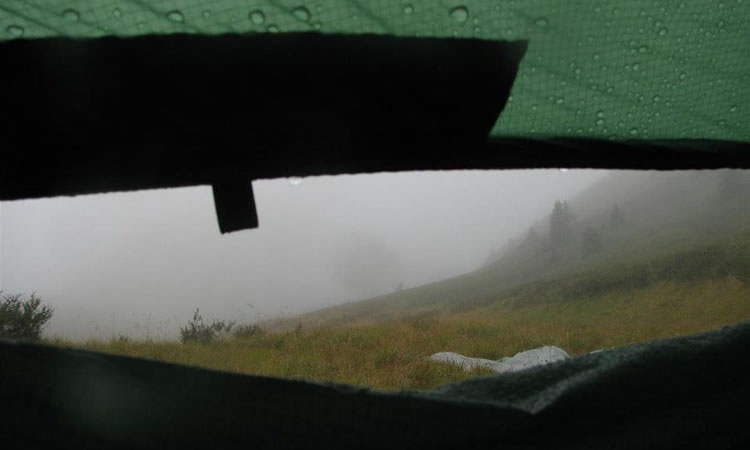
One of the options I wish I had ordered for my tent was the addition of a second zippered window on one end.  This helps greatly with the ventilation as the MK III is a single walled tent and they aren't known for their ability to breath as efficiently as a double walled tent (tent with rain fly).  To combat the ventilation issue Integral has installed some tunnel vents into the top of the tent.  They still don't provide enough air circulation though so it's a good idea to leave the door open a bit too to let the air come in and the moisture out.  There is an awning over the top portion of the door so it's safe to leave the top of the door unzipped 5 or 6 inches which does make a big difference.

The inside of the tent is made with a special layer of Nexus polyester which is supposed to act as a buffer and trap any moisture so it can be then passed to the outside.  It's very soft to the touch and when you wake up in the morning don't be surprised if it's a little damp.  You'll notice it's damp and not your sleeping bag!  This means the fabric is doing it's job.


There is enough room for 2 grown men and their gear to fit inside the tent (vestibule included) but you'd really be pushing it with 3… If you only go hunting with yourself and a partner then it's a non-issue.  If you ever want to bring a 3rd person along they will need their own tent/bivy or you'll need to bring a 3 man tent.  Don't let the high cost of this tent scare you… If you're like me you plan to be hunting for many, many years yet and this tent will last your lifetime if you take care of it.


Happy Hunting!
Carl

I've been on a few backpack sheep hunts now and every time I go the country I am in manages to chew the shit out of a pair of boots and the same goes for my feet… Hotspots and blisters making the going a little tougher.  When you're that far out in the mountains or woods it's critically important that your feet are meeting the dirt with some quality boots…

This last years hunt August 2006, my hunting partner shared with me a little shop down in Robinson Illinois, called Lathrop & Sons.  Now this is a family of hunters, who not only hunt and run a hunting boot store, but they also have a combined forty eight years of experience in Podiatry and Pedorthic fields (doctors of the foot essentially). 

A quick visit to their website revealed that I would need to complete some tracings and take some digital pictures of my feet.  It's important to have someone else complete these tracings other than yourself as if you're bending down tracing your own feet they won't be loaded correctly and the tracing will come out too small.

You'll need to provide tracings of both feet individually and take them barefoot and then also do another set of tracings with the socks on that you normally plan to wear with your new boots.  You can also take some pictures of your feet and specify and problem areas you have on your feet or any areas of concern, if you have a foot problem these guys have seen it, and know how to help you overcome the problem.

After sending away my tracings and photos I was contacted by Steven and Dusty Lathrop via telephone where we talked hunting for a good 20 minutes or so, they found out what I hunted for, what kind of terrain I was hiking on most of the time, how my old boots were, what they were, any problem areas I had with my feet etc… After several questions and answers back and forth I decided to go with the a Size 12 US and the model I chose to go with was the HanWag Alaska Trapper Top.  I like the added support for my ankles when carrying a heavy pack over the lower cut GTX model.

Along with the boots "system" I was also getting a set of the Lathrop & Sons "High Country Footbeds", a bottle of G-Wax leather waterproofing, 3 pairs of Thorlo hiking socks, and 2 Dri-Zone boot driers.

It took a few weeks to get the boots and when they finally arrived It was exciting… They arrived the same day as my Zeiss Spotting Scope but that's another review… It was just like Christmas… with a sour twist… Because these boots were made in Germany there was a 20% duty to import them… They aren't cheap! If you decide to order a pair make sure you take this into consideration or if possible go through a Canadian dealer if you can find one.  Even with the duty hassle, the personal service and attention to detail that I received has made my selection in a boot provider that much easier…   Even with all of the hassle let me tell you, these boots were worth every penny!

After walking hundreds of miles in what now seem like crappy boots, The difference is like Night and Day…  When I first tried them on they were a little tight, and I was even skeptical that we'd chosen the correct size…  I have a slightly wider foot and the HanWag seemed to me to have a narrower fit…  After a phone call from Steven, and assurance that the boot would break in and fit like a glove I decided to keep the boots and take their word for it.

To waterproof these boots I used the G-Wax that Lathrop provided with my order and applied exactly as the instructions said.  So far so good.  It was extremely easy to apply and it only slightly darkened the leather.I haven't had them out in any serious wet weather or wading any rivers yet but they do seem to shed the rain and water from low hanging brush no problem.

The "High Country Footbeds" that came with the boots are probably some of best footbeds I've ever used in a boot.  Over the last 3 years I've spent about $200 on other insoles and inserts to help alleviate some of the stress on my feet and none of them compare… I even tried the super expensive ones that you mold to your feet by cooking in the oven.  And those were probably the worst of them all!

At the time of writing this review I've now put about 50 miles on these boots with my 60lb pack on.  These miles have all been on local hills and I've probably climbed/descended 40,000 feet (both ways).  It took a few miles but I have to say that Steven was right… They now fit like a glove… Every step I take in these boots feels good… The fit is perfect and my feet feel a lot better too.  The ball-bearing lacing system helps you get just the right amount of "snugness" and really keeps the boots wrapped around your foot preventing any slippage from occurring.  Blistering or hot spots was not even a problem during the break in period and will probably never be an issue in the future with these boots.

Climbing rough and uneven terrain with these boots is a breeze as they grip like sandpaper even when trying to scramble up wet rock, which can be a deadly situation in some boots. Because of the extra rubber on the heel it almost provides some forward assist while walking, keeping your feet in a better position which ultimately makes your feet feel better and last longer when you are pounding on them for several days.

I am looking forward to getting these boots out into the "real" mountains up north so I can quit hiking the same scenery on these local hills.  After 50+ miles in them now the boots have broken in nicely and they still feel great on my feet.

If your interested in purchasing a set of HanWag boots you owe it to yourself to call Lathrop & Sons (618)544-8782

Happy Hunting!
Carl


Well this year three of us from our hunting group put in for Spring Bella Coola Grizzly Bear for 2007 and 2 of us were drawn in two different areas.  5-09C and 5-08B.  My Dad & I's area was in 5-09C and was sort of North - North West of Bella Coola.

We had a few local connections, that provided us a pile of great information and we decided to head up to Bella Coola on the 8th of May.  The highway from Vancouver up to Williams Lake and then into Anahim lake was great,  It's just a short ways passed Anahim lake you'll run into the legendary "Hill" that the residents simply refer to as "The Hill" and nasty, twisty, steep hill it is too with a near 19% grade and absolutely no guard rails.  It would be fun to a tow boat down, make sure you have good brakes, and enough power and efficient cooling to make it back up. 

My dad has a friend that lives in Bella Coola and was kind enough to loan us his boat which was an 18 foot aluminum.  It handled the local waters great.  We weren't too worried about having a boat to sleep in as we had arranged accommodations at a local resort that is current under construction at the Nascall Bay Hotsprings.

The ride from Bella Coola to Nascall Bay was about 1.5 hours in our boat, and the roughest part was coming around the mesachie nose and into Laboucher Channel.  Once inside Laboucher it was near dead calm, and calm as well through dean channel and right into Nascall Bay where we were Greeted by Frank (lodge owner) and his crew of happy helpers.

The lodge is outfitted with a complete dock and gas facilities, restaurant, cozy cabins, hotsprings, and even wireless satellite Internet.  The Tap Water comes straight out of the mountain springs, and is gravity fed down to the lodge and I must say it's some of the best tasting water I've ever had. 

After we arrived and got settled into our room we decided to head out in the boat and do some fishing so we could catch some bait for our crab traps.  After a few minutes we had a couple of cod that we wired into our traps and dropped them in a little spot called Eucott Bay, just a little ways southwest of the lodge.  This was recommended to us by several different locals and proved to be productive.  We each took home our limit of 12 crabs over the few days our traps were down and these crabs were big, we caught so many that I only selected the finest crabs, with all 8 legs and 2 pinchers throwing everything else back.

While the seafood was great it wasn't the only purpose we were there… Our real goal was to fill a Grizzly bear tag.  And the fishing and crabbing was mainly just a filler during the middle of the day, when the bears are all snoozing like most every other critter.  Once 2 O'clock hit we were at the flats and just still hunted until dark.  2 nights went by without seeing a thing aside from some seals and the odd porpoise or two… 

On the third evening we were sitting in the bay, watching the flats and I decided to crack the new Zeiss Diascope 85m Spotting Scope out and see if I couldn't find some goats… Several hours had gone by without any action so I wanted to pass the time… I started glassing the mountainside across from us in Dean Channel and quickly spotted 3 goats feeding on the edge of a small waterfall… It would have made a nice picture if I weren't close to 2 miles away.  I continued watching the goats until I heard my partner mumble… "I am not sure if this is a black or a grizz…" I quickly turned around and saw a big dark colored mass coming out of the heavy rainforest and onto a small section of tidal flat…  My partner didn't have his binos handy right away so I threw mine up and knew instantly it was a Grizz…

It turned out the bear was about a 7 - 7 1/2 foot boar and he did have a really nice coat on him,  His back was a lighter blond color while his arms, and legs were a very dark brown.  The bear had been in a few tussles as he had a big scar across his forhead.  We hummed and hawwed at the bear for close to 1/2 an hour and then decided we'd hold out for a bigger bear…  You know how it goes sometimes, and we never did see another bear the whole trip!

Click Here To See The Grizzly On Video


The 2007 Spring Grizzly Hunt Allocations Were Released On Monday.

This is the number of tags available for the 2007 spring hunt draw and for the most part it looks like there has been quite an increase in tags available to certain areas. For some of the sub-regions the numbers appear unchanged or they have shifted a few tags from one sub-region to another in a few cases as well.

2007 Spring Grizzly Hunt Tag Allocations

The areas I put in for Spring Grizz the allocations increased 300% for my 1st choice and 500% for my 2nd choice area so I am pretty excited about that. If you haven’t put in yet you still have time! Applications must be into Victoria by 4:30 pm on
FRIDAY, FEBRUARY 9th. Notification of draw results will be sent on February 20, 2007.

If you’re this late though I would courier it to Victoria.

Good Luck!
Carl

Every year in BC and across Canada for that matter law abiding hunters may by accident wound or lose a big game animal such as a Moose or a Black Bear. Unfortunately if a hunter doesn’t have access to some trained tracking dogs recovering the animal can be next to impossible depending on the situation.

The Canadian Game Trackers Association hopes to change that… They are a new organization created by Canadian hunters who are also active houndsman. The goal of the association is to help regular hunters in legal situations recover their lost or wounded game animal.

Canadian Game TrackersMany of the founding members of the Canadian Game Trackers Association own and work with or have direct access to their own highly trained game tracking dogs. Their trackers are extremely active and have many years of tracking experience. As a group they are responsible for recovering many wounded or lost big game animals every year. Now they want to offer their tracking dog services to not only their clients on guided hunts but also to resident hunters who may need the service of trained tracking dogs at some point.

The Canadian Game Trackers will track with their dogs solely within the laws of the province or territory they are located in and only in situations where the animal was harvested legally.

The association’s goals are to:

  • Promote the use of trained tracking dogs to recover lost or wounded game animals.
  • Raise awareness and educate about the value of tracking dogs.
  • Provide help and assistance to existing and future tracking dog handlers.
  • Offer training seminars to others interested in learning more
  • Click Here To Visit The Canadian Game Trackers Website

    Happy Hunting!
    Carl

    Backpack Hunting For Sheep


    Backpack hunting for sheep is a serious hunt. It’s physically and mentally demanding. You need to be able to pack at least 40-50 pounds on your back going in. And If you are lucky enough to take a sheep you are coming back out with closer to 100+ pounds worth of Gear, Meat, Horns & Cape. So you don’t want to be packing a lot of excess or heavy gear.

    I’ve been on a few backpack sheep hunts now and much prefer an internal pack for this type of hunting.  Sheep are a relatively small animal and are "packable" with most of today’s heavier duty internal frame packs.  The internal is more comfortable and I find less cumbersome then some of it’s framed counterparts.

    My pack of choice right now for backpack sheep hunting is from Lowe Alpine and it’s a special expedition pack. 70+25 = 90 Cubic Liters. There are plenty of straps and pockets for all of my gear making it very easy to organize everything.  The pack is comfortable on my back and I’ve had it loaded with up to 80lbs and had no problems. If I were going on a caribou or elk hunt then I’d probably want to sacrifice comfort and go with an external frame pack.

    Aside from your pack here is a list of the items I currently pack along…

    Clothing
    - 4 Pair Thorlo Level III hiking socks. (expensive but worth every penny)
    - 2 Pair Merino Wool Sock Liners.
    - 1 mid-weight polartec fleece pullover.
    - 1 light-weight polartec fleece pullover.
    - 1 pair North Face Paramount Convertible Pants (2 pairs including the ones I wear)
    - 1 pair light-weight thermal underwear. (use these for sleeping in or on colder days)
    - 1 pair boxer shorts. (2 pairs including the one I wear - When your in the mountains nobody cares)
    - 1 light weight North Face wick away t-shirt.
    - 1 pair lightweight rainpants. (rockwater designs)
    - 1 lightweight rain jacket. (Keela)

    Sleeping/Shelter
    - 1 Lightweight backpacking sleeping bag. (good to about -5c - I will upgrade this bag soon)
    - 1 Silcoat packcover (essential for keeping your pack bone dry)
    - Prolite 4 Thermarest.  (I own 3 thermarests.  This one is nice & light and compacts very small)
    - 1 Sil-Tarp II 8′x10′. (These lightweight tarps are awesome for a fast light weight shelter)
    - 1 Integral Designs MK-3 Expedition Tent (This is the tent I am buying)

    Equipment/Optics/Misc.
    - Petzl Myo Xp Headlamp. (very bright - runs on 3 AA batteries.)
    - Handmade Hunting Knife (could shave weight here with a smaller buck or puma knife.)
    - 1 pair Swarovski 8×30 Binoculars.
    - 1 Bushnell Spacemaster II 20×40x60mm Spotting Scope. (w/lightweight tripod)
    - First Aid Kit (Tylenol,Ibuprofen,Antiseptic,Bandaids,Bandages,Gauze)
    - 1 Tube firepaste (this stuff is the best firestarter I have used yet - Perfect for backpacking)
    - 6 AA batteries. (I could probably get away with only 3 but just in case…)
    - 1 TrailBlazer Buck Saw (This handy unit breaks down into a light aluminum tube. Makes getting wood for your fire much easier.
    - 12 Federal 130 Grn .270 Rounds (3 in my magazine and 9 on the butt of my rifle)
    - 100′ Poly Rope.  (Maybe a little overkill but I like to make a good camp)
    - Tikka Lite S/S .270 W/Bushnell Elite 3200 Scope. (Great Gun - Accurate & Light!)
    - 1 Sony Handycam Video Camera (20x Optical Zoom W/Zeiss Lenses)
    - 1 Sony DSC-W50 6.0 MP Digital Camera (Great Small Compact Camera)

    Food & Cooking.

    - Jetboil Stove (w/2 Canisters fuel - Good for 10 days of boiling water for drinks and meals)
    - 2 Liter Soft Plastic Water Container (In case you need to pack extra water)
    - 1 1.5 liter Nalgene bottle (Strap to outside of my pack)

    Breakfast
    - 4 MountainHouse Granola W/Blueberries (Great Filling Breakfast)
    - 3 Packets of Maple & Brown Sugar Oatmeal (Great Light Breakfast)

    Lunches/Snacks (I don’t eat much throughout the day)
    - 6 Sun-Rype Fruit Bars.  (These are great snacks)
    - 1 Ritter Sport Almonds Chocolate Bar. (eat a few squares per serving.)
    - 1 Ritter Sport Hazlenut Chocolate Bar. (eat a few squares per serving.)
    - 2 Nut & Raisin Chocolate Bars. (eat a few squares per serving.)
    - 1 ziploc bag with either Gatorade mix or Iced Tea mix.

    Dinners. (all mountainhouse)
    - 1 Chicken Teriyaki W/Rice.
    - 1 Turkey Tettrazinni.
    - 1 Beef Stew (Really Good)
    - 1 Chili Mac W/Beef.
    - 1 Noodles W/Chicken.
    - 4 Pasta Primavera (Really Good)

    Total Pack Weight = 45 lbs W/Rifle.  (It will be about 51 lbs with my tent when I get it)

    One of the biggest challenges when getting your pack ready is how to efficiently pack everything so it’s going to be easy to locate and repack should you need to.  As you can see in the photo below there is a lot of gear here!


    Sheep Hunting Gear
    (All Of My Gear For 7 Days Sheep Hunting In The Mountains)

    One of the best things I have found is to use those thin mesh draw string bags that so many camping/backpacking supply stores now carry.  I can organize all of my gear into the mesh bags and it keeps everything together and packed as tightly as possible.  The less volume your pack has the easier it is to navigate through heavy brush or tricky situations.

    Here is a another photo of all the same gear but now I have reorganized my Clothes, Socks, and Food into the mesh bags. Look at the difference. It’s much more organized and makes it so much easier to handle when you are out in the field. The last thing you want to do is tear apart your bag and repack the mess while your out hunting or on your way to camp. When I am hiking I go non-stop until I reach where I am going.


    When packing my pack I lay the food in the big mesh bag to your right on the bottom of my pack. I then put my clothes on top of them trying to keep the heavier items towards the center of the pack. I make sure everything is strapped down and the zippers are all closed, nothings hanging out anywhere.

    Here are some photos of all of my gear packed up and ready to go.  This backpack has some handy straps on the side that work excellent for carrying my rifle around.  Usually I prefer to carry my rifle in my hands but sometimes when you are going up a steep climb or side hilling along a mountain creek it’s nice to have free hands. (My tent will be attached near the bottom via 2 large buckled straps)


    (Here is all my gear fully packed up and ready to hit the hills)

    I hope this article helps some of you sheep hunters out there!

    Happy Hunting!

    Carl


    This year in November I hunted for 10 days in the cold of region 7. Unlike the last few years there was actually snow this year during deer season. There was at least a foot of snow when I got there and it kept pouring down pretty much daily while I hunted. This was good in a way because it really concentrated the deer into specific areas for feeding and thus they were much easier to pattern and setup for an ambush.

    I primarily still hunt for whitetail and hunt mule deer along the way. This year I wanted to concentrate on getting some great footage for the website to share with avid other bc hunters. If the right buck came along then I’d have to take one. With the knowledge that I would be taking a buffalo from a private ranch and would be going home with nearly 400 pounds of prime grain fed meat anyways the urge to take a small buck was not there.

    I arrived late in the afternoon on the 8th and headed out for a quick scout of the area I would be hunting which is 9 sections of private land. Much of the area is timbered and it backs onto a major watershed. It’s prime big buck country and has produced several big bucks over the years. The snow being so deep limited where I was able to go on the property which turned out to be okay as the deer weren’t going there either.

    I was walking down the edge of the road in the deeper snow trying to stay of the really "squeeky" stuff and started to come over the hillside when I saw a few black dots out in the field. They turned out to be a few does… I kept walking down towards one of the ravines on the property, it’s around 100 meters wide in some spots and fairly deep with some sparse timber and underbrush. It leads directly into several more of these gulleys along the many smaller watersheds in the areas.  The muley bucks here tend to like to travel in these areas and will often use the creeks as their travel routes.

    As I broke out of a block of timber I looked to my right out into a big open field. There was a lone deer that had just popped out of the creek maybe 600 yards away he was jogging through the deep snow on his way into a big block of timber that leads to another alfalfa field. I quickly put the glasses up and realized it was a good 4×4 muley. He was fairly heavy but still really far away and I didn’t have my spotting scope with me. I had no cover and he would be in the timber before I could even get within a reasonable shooting range so I patiently watched him do his thing and kept a mental note of where he headed.

    After a few hours of hiking around and checking out some trails and rubs etc.. I went and hopped back into the truck to get ready to still hunt for a whitey. I think trucks and farm equipment make about the best ground blinds you can use when your hunting deer in this type of country. They are used to vehicles driving around.


    The whitetail were primarily hanging around the bails of alfalfa on one of the upper fields. This would be the spot for my ambush. I wasn’t there 5 minutes the
    1st night and this guy showed up.  He had one really nice eye guard going for him but that was about it.  The opposite eye guard looked like it never actually grew rather then being broke off.  I watched this buck on several occasions and you’ll see him on the video.

    The second night was when things heated up a little.  I had arrived in my spot at about 12:30pm and was going to sit there until it was absolutely dark.  There were a few smaller bucks and several more does on and off the bails through out the day.  At around 5:20 pm I happened to look in my rear view and see a big bodied deer coming right up the road behind me.  I turn
    around and throw the glasses up and see that he is a pretty good whitetail buck!

    He was warry of my truck and was approaching fairly slowly.  I had the video camera on him and could see he was a heavy 5×6 but he didn’t have very
    much height to his rack.  His back right G2 was as thick as a banana which I thought was neat.  The buck was probably 400 yards away and still approaching slowly so I decided to help him out a little and sprayed a bunch of doe estrus out the window.  Watching him through binoculars he would curl his lips and then start coming at a quicker pace.  It was snowing heavily and the wind wasn’t in my favor.

    You’ll see him in the video as he goes past me and comes out in front… The video cuts off as I was actually getting ready to take this buck.  I got out of the truck and crawled behind a haybail.  I threw a shell in the chamber put the gun up and locked onto the bucks chest as he was facing me… I held there until he quartered and then decided I wasn’t going to shoot.  It was only the 2nd day into my hunt I and knew there were bigger bucks.  He was a nice buck though…

    You can find the video of him in my Gallery. 

    Big Whitetail Buck Video
    (For some users the video shows up really dark, others light enough to see fine.  No idea!)


    While I was up there I met up with another hunter in the area someone whom I met through HBC when we got to talking we found out we actually had permission on one of the same areas so we went out and checked it out for a day.  Saw a few deer including a smaller 4×4 muley.  He ended up taking a 5×4 whitetail off the property.  A great buck considering the pressure the area seemed to be under this year.  I’ve never seen so much deer sign in one field in my life.  They had actually eaten up entire windrows for the full length of the field…  You could see where the deer had pawed it all up.  Tracks, Trails and Beds everywhere!

    Another highlight of the trip was seeing my first Cougar.  We were pulling into the property and about to reach the gate when my partner spotted a buck run across the road 400 yards ahead of us.  It looked like a legal buck but we never did get a closer look.  We stopped and waited a few seconds and another head slowly emerged from the where the buck had came.  I quickly threw my binoculars up and realized right away it wasn’t another deer but the big hairy face of a cougar!  I was surprised to say the least.  There are cougars in this region but they are few and far between.  I tried to get my Camera turned on and ready to get some film but the Cougar had turned tail and run the opposite way before I even had a chance.  We went and checked out his tracks and the snow was so deep  you couldn’t see the paw prints.  Just the marks from it’s belly dragging in the snow.  If we hadn’t of interrupted I
    think the cat was probably stalking the buck for dinner.  That would have been awesome to catch on film.


    The next few days brought much of the same deer into the area with at least one new buck coming out to feed every day.  By the tracks and trails left by the bucks it was obvious the big guys were coming out later in the evening into dark.  I was hunting the tail end of the season and there was one whitetail taken of this property that I knew of earlier on.

    This buck on the left was probably the second biggest whitetail buck that I came across this year.  He
    was a good 4×4 but lacked a bit of height and mass.  He is going to be an impressive buck in a few years though.  I’ll be watching for him.

    There is some good video footage of this buck play fighting with some of the smaller bucks that were out this particular day.

    Most of my time was spent still hunting whitetails.  Although I did go hiking a few days through some of the blocks of timber between fields looking for a muley which turned up nothing but a pile of sign.  I did see plenty of legal bucks while using the truck as a ground blind though :)   I have held out on mule deer for the last 3 seasons now.  Maybe next year will be the year I run into my buck…

    I hunted long hours everyday and never did come across any bucks that I wanted so I’ll be eating tag soup this year.

    Here is some of the video footage that I took on this trip. 

    The video is almost 5 minutes long and has a few different whitetail and mule deer bucks that I encountered along the way.  I hope you enjoy.  It’s time to get busy planning my LEH Mountain Goat hunt in region 6. 

    Happy Hunting!

    Carl

    PS… I forgot to post this first time around. I purchased a buffalo from a rancher in the FSJ area and went out to the ranch the morning of the day I was leaving. I took a hefty 2 year old bull and ended up with close to 400 pounds of some the finest meat available. No growth hormones.
    Click Here For The Buffalo Shooting Video

    Well it’s that time of year again… I am busy packing up all my gear to head north Wednesday AM on the first ferry. I’ll be headed to Fort St. John for the annual deer hunting trip and will hopefully return with some real good video footage for the site and maybe some pictures of the bucks I pass up :)

    If I play my cards right and put the time I hope to be rewarded with a nice buck (or two)

    I’ll also be going to take a farmed buffalo for meat. I’ll video that too for everyone :)

    Happy Hunting!
    Carl

    Next Page »